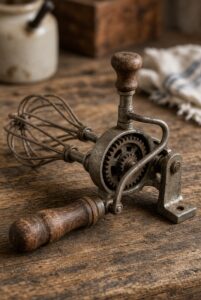
Before electric mixers took over kitchen counters, the hand-cranked rotary egg beater turned baking into a fully hands-on experience, its wooden handles, metal gears, and wire whisks familiar in many homes. Emerging in the late nineteenth and early twentieth centuries as inventors searched for practical ways to simplify cooking, it soon became standard equipment in American and European households from the 1940s through the 1960s, used for everything from biscuits and pancakes to omelets and cakes. Unlike modern appliances that work at the push of a button, this tool demanded patience, attention, and steady movement. Children often learned these qualities while helping in the kitchen, turning the handle as the whisks spun, and cooking became a shared activity built around simple, meaningful tasks.
For older generations, a worn rotary egg beater can instantly recall childhood kitchens, holiday baking, birthday cakes, and Sunday breakfasts. The clicking gears and spinning wires evoke the satisfaction of watching cream thicken or egg whites rise, and many of these tools were passed between generations, carrying family traditions and memories of a time when the kitchen sat at the heart of home life. Today, vintage rotary beaters appear in farmhouse kitchens, museum displays, and collectors’ homes, while modern replicas celebrate their timeless design and appeal to people who value traditional methods and slower living. Even with today’s advanced kitchen technology, this simple hand-operated utensil still delivers impressive results without electricity or complicated controls, symbolizing human ingenuity, practical design, and the enduring value of hands-on experiences in a world increasingly focused on speed and convenience.
Leave a Reply