Across the Road
“Aunt Melissa,” Luke said again, and then he didn’t seem to know what came next.
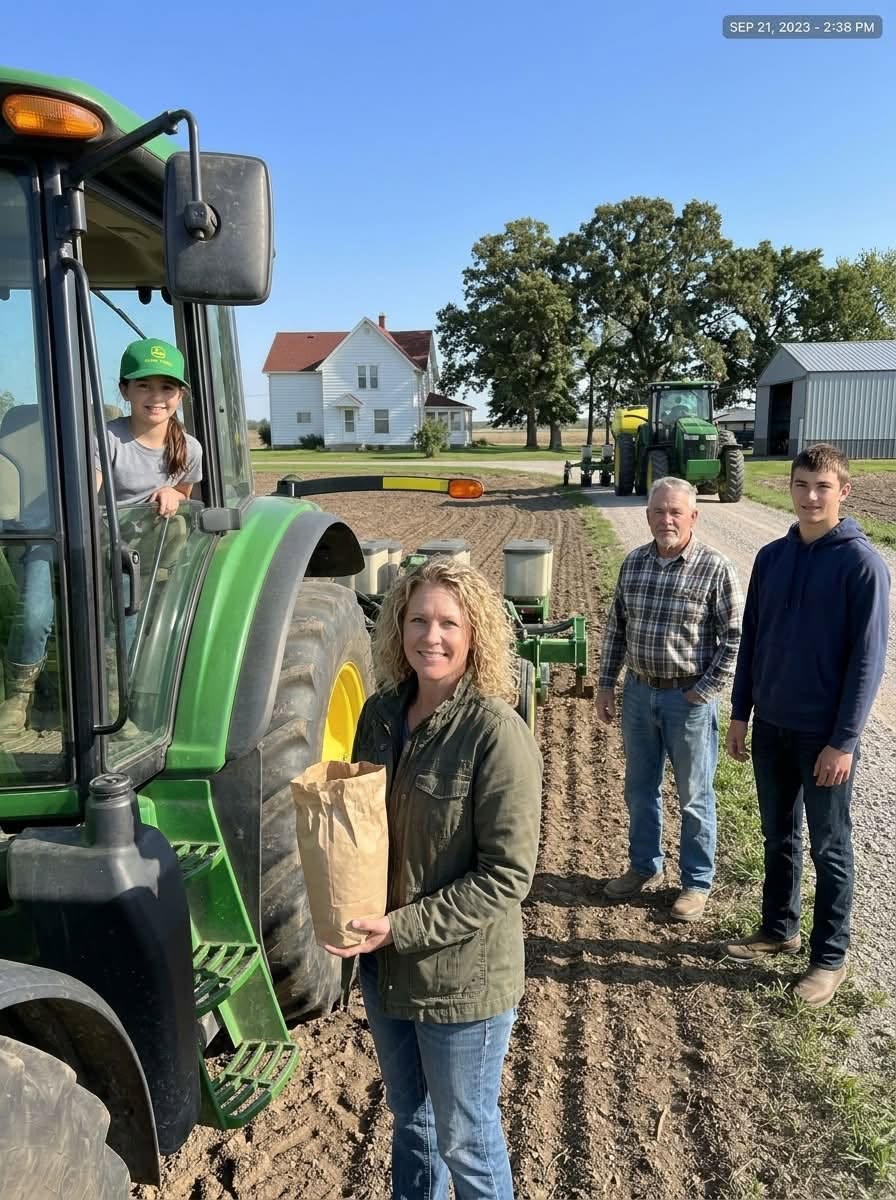
He was twenty-four, tall and sunburned and rawboned, with Jeff’s ears and Randy’s stubborn jaw, wearing a dusty ball cap and a pair of work boots that had walked a hundred miles of that gravel. He stood at the end of my rows with his hands hanging. Behind him, across the road, the tractor kept making its passes, and Randy stood perfectly still at the edge of the field, watching his son stand on my ground.
“Your planter’s skipping,” Luke said.
I looked at him.
“Third row from the left. I could hear it from the road. It’s plugging on the seed tube.” He swallowed. “You’ve got a gap running about two hundred feet. You’ll see it in June.”
I turned and looked down the field. I’d planted a long, straight, careful pass, and I’d been proud of it. I hadn’t noticed.
“Can you fix it?”
“It’s a five-minute thing.” He glanced back at the road. His father hadn’t moved. “If you want.”
I looked at Abby, in the buddy seat, in her father’s cap, holding very still.
“I want,” I said.
My name is Melissa Brandt. I’m forty-four, and until March I had never in my life driven a planter. I kept the books.
Jeff and I married in 2005, in the Lutheran church in Hebron, Nebraska, a month after I finished my accounting degree at Kearney. He was a farmer’s son, easy and big and slow to anger, with a laugh that could carry across a section. He farmed with his brothers on land their father, Walter, had pieced together over fifty years: three thousand acres of dryland and irrigated corn, soybeans, and milo, near the Kansas line. The operation was a partnership, Brandt Brothers Farms. Jeff held a third. Randy and Scott held a third each.
I did the books. Payroll, fuel, seed, the Farm Service Agency paperwork, the crop insurance, the operating loan with Thayer County Bank. Twenty years of it, at a desk in the farmhouse office, with a dented calculator and a calendar from the elevator. I knew where every dollar went. I knew who’d paid on time and who hadn’t. I knew exactly how much the operation owed.
That’s the part I held on to, afterward.
We lived in the white two-story on the home place, a house Walter had built in 1962, with a deep porch and a kitchen window that looked east over the fields. We had one child. Abby is twelve, thin, serious, with Jeff’s gray eyes and my habit of reading the room before she speaks. She came into the world on the first of June, in a thunderstorm, and Jeff drove us to the hospital in Hebron with a tractor headlight swinging on the dash.
He died on the nineteenth of March, at forty-seven, in the shop, with a socket wrench in his hand. A heart attack. Randy found him. The ambulance came from Hebron in eleven minutes. It didn’t matter.
I don’t remember the funeral well. I remember that it snowed, a late, wet, heavy snow, that came down on the cemetery in the way of a blessing nobody wanted. I remember the casket, plain oak, carried by six men, with Luke at the front left corner, crying openly all the way down the aisle. I remember Abby’s hand in mine, small and cold.
And I remember the lunch.
It was in the church basement, six days later, on a Tuesday, at one o’clock. The Lutheran women had done it, as they do. Ham buns, scalloped potatoes, a lime Jell-O salad, three kinds of bars, a vat of coffee. Two hundred people had come. They filled the long folding tables, in their good coats, speaking in the low, kind, buffered voices of people who’ve done this before.
I sat at a table near the back, with a plate I hadn’t touched.
Abby was two tables away, with her cousins, twelve years old, in a navy dress I’d bought for her the day before, pushing a lemon bar around her plate with a plastic fork.
I felt, more than saw, the two men approach.
Randy pulled out the chair across from me. He sat down heavily. He’s fifty-one, thick-shouldered, silver at the temples, with Walter’s flat blue eyes and a way of looking at the middle distance when he’s uncomfortable. Scott sat beside him. Scott is forty-nine, leaner, quieter, in a gray sport coat that didn’t fit, with a habit of tapping his thumb against the table.
“Melissa,” said Randy.
“Randy.”
“How are you holding up?”
“I’m here.”
He nodded. He glanced at Scott. Then he reached into the inside pocket of his coat and drew out a long white envelope. He laid it on the plastic tablecloth, between my plate and the coffee, and pushed it gently toward me with two fingers.
“It’s the buyout,” he said quietly. “Like the agreement says.”
I looked at the envelope.
I knew what was in it. I knew before I touched it. In the corner, in the bank’s neat type, was the return address of Thayer County Bank, and my name, and the words Cashier’s Check Enclosed.
“Five hundred thousand,” said Randy. “It’s the full amount. Jeff’s third, valued at book, per the buy-sell.”
“I know the number.”
“Of course you do.” A small, uncomfortable smile.
“The house belongs to the partnership,” said Scott. He didn’t look at me. He looked at the thumb he was tapping. “It’s titled to Brandt Brothers. We’d need you out by planting.”
“By planting.”
“Early May. Maybe sooner, if you can.” He cleared his throat. “Luke’s coming home. He’s going to farm. He’ll need the house.”
I looked at the two of them. At the ham buns. At the cooling coffee. In the distance, I heard a child laugh, one of the little cousins, a high clear sound in the low hum of the room.
I thought, very calmly: They’ve waited six days.
I want to be fair to them. I think it’s important.
Randy and Scott were not villains. They were farmers, in a hard time, doing what the paper said. The buy-sell agreement was real. Jeff had signed it, in 2016, at a lawyer’s office in Hebron, along with his brothers, at a time when Walter’s health was failing and the family was frightened of what might happen to the land. It said, in plain legal English, that on the death of any partner, the survivors had the option to purchase his interest at book value, payable in cash within ninety days. It said the surviving spouse would vacate partnership property within a reasonable time.
I knew it by heart. I’d typed it.
I also knew something else.
I knew, because I kept the books, that the operation was in trouble. The previous two years had been bad. A drought in ’22, a hailstorm in ’23, and a corn price that had dropped under four dollars. The operating loan at Thayer County Bank had grown to $1.8 million. In January, the loan officer, a decent, sweating man named Dale Pruett, had called Randy into his office, and then Scott, and then, at last, me. He’d laid out a spreadsheet. He’d said, “I’ve got to bring this to the board.”
The bank had been putting pressure on them since January.
They needed the five hundred thousand to be gone from the partnership’s obligations. They needed the house to be free, to be pledged. They needed, I understood, a clean balance sheet and a fresh loan, and a widow in the farmhouse was an encumbrance.
And Jeff, God rest him, was dead, and could not say a word.
I didn’t argue.
I’d like to tell you I wanted to. I wanted to stand up in that church basement and say what I knew. I wanted to say, You’ve known for six days what to do with my husband’s third, and you’ve known for six weeks, since the doctor’s appointment, since the stress test. I wanted to say, He told me you’d been pushing him. I wanted to say a hundred things.
Instead, I picked up the envelope.
It was heavier than it looked. A fat, stiff, official thing. I held it for a moment in my two hands. Then I opened my purse, a black leather one Jeff had given me for Christmas, and I laid it inside, between my wallet and a packet of tissues.
I snapped the clasp.
“All right,” I said.
Randy looked, for a long moment, almost relieved.
That was the part that stayed with me. Not the check. Not the deadline. The look on my brother-in-law’s face, when I said yes. A loosening of the jaw, a sag of the shoulders, the face of a man who has braced for a blow, and found it didn’t come.
He thought it was over.
I cashed it on Monday.
I drove to the bank in Hebron in my old Silverado, in my funeral dress, with Abby in the passenger seat and a cold rain coming down on the fields. Dale Pruett met me in the lobby. He’s a rumpled, sweating man in his fifties, with a mustache, a bad tie, and an air of perpetual apology. He took me into his office and shut the door.
“Melissa,” he said. “I’m so sorry.”
“Thank you, Dale.”
“I know it’s, I know the timing is, I want you to know I argued against it. I said, at least wait till after the funeral.”
“I know you did.”
“The board’s, they’re very nervous. About the loan.” He rubbed his face. “I’d like to say it’s nothing personal.”
“It isn’t.”
“It’s just, the partnership needs, there’s a covenant. They had to show liquidity.” He looked miserable. “I’d like you to know that this isn’t how I’d have done it.”
I set the envelope on his desk.
“I want to deposit it,” I said. “Into a new account. In my name. Melissa Brandt, individually.”
He blinked. “Of course.”
“And I’d like a cashier’s check back out of it, in thirty days. For a purchase I’m considering.”
“What purchase?”
“I’ll tell you when I’m ready.”
He looked at me for a long time. Then he picked up a pen.
“Melissa,” he said. “Is there anything I should know?”
I thought about it.
“Dale,” I said. “How long have you been a loan officer?”
“Twenty-six years.”
“In that time, how many widows have you seen sign away a farm?”
He put down the pen.
“A good many,” he said quietly.
“And how many of them came back?”
He didn’t answer.
“I’d like to be the first,” I said.
The old Wiebe place had been on the market since the fall.
I’d driven past it a thousand times. It sat directly across the gravel road from the home place, a mile and a half from the nearest neighbor: eighty acres of dryland, a quarter section minus a corner, with a small, white, two-story farmhouse set back among overgrown lilacs, and a leaning machine shed with a roof like a swayed horse. Old Carl Wiebe had farmed it for forty years, and when he died, his children had scattered, and the place had stood empty for three.
I’d always loved it. I’d looked at it every morning from my kitchen window, over a coffee cup, and I’d thought, someone ought to live there.
It was listed at $430,000. It had been listed at $480 in September, and dropped twice. The realtor, a quiet, silver-haired woman from Superior named Dorothea Amundsen, had a For Sale sign at the end of the drive that had been bent by two winters of wind.
I called her on Tuesday.
“Mrs. Brandt,” she said. “I was so sorry to hear about Jeff.”
“Thank you. I’d like to see the Wiebe place.”
A pause.
“The, I’m sorry? The Wiebe…”
“I’d like to see it. Today, if you can.”
“Of course.” I heard her shuffle papers. “May I ask, are you, I’d understood you’d be, that the family…”
“I’m going to stay,” I said.
She was silent for a moment.
“Come at two,” said Dorothea Amundsen. And then, more softly, “Bring a flashlight. The power’s been off.”
I walked through that house in a long gray raincoat, with a flashlight, and Abby beside me, her sneakers squeaking on the old linoleum.
It was a plain, small, sturdy house. Four rooms down, two up. Pine floors, cracked plaster, a stairwell that smelled of mice and cedar. A kitchen with a deep, chipped, porcelain sink, and a window over it that looked, directly, across the gravel road, to the home place.
I stood at that window for a very long time.
I could see the white farmhouse, with its porch. I could see the barn, the shop, the grain bins like silver bells. I could see the long flat fields, brown and wet, stretching away to the line of cottonwoods on the creek. I could see, at the edge of the nearest, Jeff’s tractor, a faded red Farmall, parked where he’d left it in March.
“Mom,” said Abby, softly.
“Mm?”
“Are we moving here?”
I thought of a funeral lunch. A white envelope. We’d need you out by planting.
“I’m thinking about it,” I said.
“Everybody says we’ll move to town.”
“I know.”
“Aunt Kathy said, at the lunch, she said you’d probably take the check and get a place by the school.”
“I know she did.”
“Is that what you want?”
I turned from the window. I looked at my daughter, at her thin, serious face, her gray eyes, her braid.
“No,” I said.
“Why not?”
“Because your dad’s fields are across that road.”
She looked past me, out the window.
“I want you to wake up,” I said, “and see them.”
I closed on the twenty-second of April.
It was a quiet, gray, windy morning, and the closing was at a title office in Hebron, in a room with a long laminated table and a stack of forms. A young attorney named Kristin Okafor read the documents. Dorothea sat beside me, in a tweed jacket, with a thermos. Dale Pruett had brought the cashier’s check himself, and held it out, with a look I couldn’t read.
“Four hundred thirty thousand,” he said. “As requested.”
I signed forty-one pages.
Melissa A. Brandt, a widow, grantee. I read each one. I read every line. I asked three questions about the water rights, and one about an easement along the north fence, and Kristin, who was twenty-eight, said with a wry, startled glance at Dorothea, “Mrs. Brandt, you’re the first buyer I’ve had who caught the setback.”
“I kept books,” I said.
They handed me a key. A single, old, brass key, on a loop of twine, with a paper tag. Wiebe — Back Door.
I put it in my pocket.
“Congratulations,” said Dorothea Amundsen. She took my hand, and held it a moment in both of hers. “I’ve sold farms for thirty years. I’d like you to know I’ve never been so pleased to hand over a deed.”
“Thank you.”
“May I ask what you’ll plant?”
I smiled.
“Whatever I can,” I said.
I didn’t tell anyone.
I’d like to say it was strategy, and some of it was. Mostly it was something quieter. I’d learned, in the weeks since March, to keep my own counsel. I didn’t tell Randy or Scott. I didn’t tell my mother, in Fairbury, or my sister, in Lincoln. I didn’t tell the women at church, who were already organizing a casserole rotation for my “transition.”
I just moved.
I did it in three days, in the last week of April, with a borrowed trailer and a crew of two. My friend Dolores from the elevator, a big, rawboned woman of sixty with a voice like a foghorn, brought her son and his flatbed. A neighbor boy, sixteen, carried boxes. We loaded the Silverado and the trailer, and made six trips across the road.
The house on the home place, the white two-story, I left clean. I scrubbed the floors. I washed the windows. I left the porch swept. On the kitchen counter, I laid the keys, three of them, and a note in my careful bookkeeper’s hand.
The books are in the office, up to date through March 31. The FSA file is in the second drawer. —M.
I closed the door, and I walked across the gravel road, with Abby, carrying the last box.
We did not look back.
With what remained, I bought machinery.
I’d spent a long weekend reading the sale bills, in the Nebraska Farmer and on a website that only old men used. A farm sale in Red Cloud, on the second Saturday of April, had a green 1998 John Deere 7610, with a cab, and an eight-row planter, a John Deere 7300, with a seed-monitor that still worked. A farmer there had died. His widow was selling.
I went alone.
I stood in a muddy lot, among sixty men in seed caps and bib overalls, with a bidder’s number on a card. The auctioneer was a skinny, sing-song man in a cowboy hat. I raised my number, and I kept it raised. A man beside me, grizzled, in a Pioneer cap, gave me a long, sidelong look.
“You know what that is, ma’am?”
“A tractor.”
“That’s a 7610. It’ll run forever.”
“That’s what I’m counting on.”
I got it for $38,500. The planter, $14,200. A used grain drill, a sprayer with a cracked boom, a cultivator, and a tank of anhydrous that Dolores talked a cousin out of, for a handshake. In all, with seed and fertilizer and a first payment on a lease for the neighboring forty, I spent $97,000. It was, I’ll tell you, less than a good combine.
I drove the tractor home on the highway. It took two hours. I went thirty miles an hour, with the flashers on, in a convoy of one, and men in pickups honked and waved. A boy in a school bus pressed his face to the glass and gave me a thumbs-up.
I had never been so frightened in my life. Nor, I think, so awake.
The first week of May came in cold and bright, with a wind from the north.
I woke at five on the Monday. I made coffee in the Wiebe kitchen, in a percolator I’d found in a cupboard, and I stood at the window, with a mug in both hands, and watched the sun come up over the home place.
Abby came down the stairs in her pajamas. She had her father’s cap on.
It was a faded green seed cap, with a Pioneer logo, soft and sweat-darkened, that had hung on a hook by the back door of the old house for twenty years. I’d found it in the last box. It came down over her ears. She’d stuffed her braid up into the crown.
“Mom?”
“Yes, love?”
“It smells like Dad.”
I put down my cup. I crossed the kitchen and knelt, and she put her arms around my neck, and for a while neither of us spoke.
“I’m wearing it,” she said, finally, muffled, against my shoulder.
“I know.”
“Even if it’s too big.”
“It’s perfect,” I said.
She wore it all day.
They pulled onto Jeff’s ground at seven.
I was in the yard, in my coveralls, checking the hitch on the planter, when I heard the engine. A big, red, Case IH, a 340 Magnum, with a twelve-row planter behind it, the one Walter had bought in 2012. It came down the lane from the home place, slow and deliberate, and turned in at the gate to the north field, the quarter section along the road.
Scott was driving.
I knew the way he held the wheel. Stiff, upright, with one forearm along the sill.
I watched him lower the planter. I watched him drop into gear. And I watched the long dark line of the first pass unspool behind him, over Jeff’s ground, the quarter he’d farmed since he was nineteen, the quarter where we’d buried his father’s ashes at the corner post.
I did not look away.
I climbed into the cab of the green tractor.
It started on the second try. A low, rough, honest rumble. I eased it into gear, and it lurched, and I corrected, and it settled. I lowered the planter. I gripped the wheel, with sweating palms, and drove through the gate onto the Wiebe ground, eighty acres of dryland that hadn’t been turned in three years.
The same morning.
The same hour.
Across the road, Scott’s tractor made its pass. I made mine.
Nobody waved.
I’ll tell you what I felt, because I think it’s the point.
It wasn’t triumph. I’d have been ashamed of that. It was something quieter, and older, and a good deal more frightening. It was the feeling of putting a seed in the ground and having no idea whether it would come up.
I’d never planted. I’d kept the books for a farm for twenty years, and I’d never once sat in that seat. I knew what a bushel cost. I knew the break-even on corn at three-ninety. I knew every dollar of the loan. But I didn’t know how to read a soil temperature, or when the moisture was right, or how deep a seed should go, or what the monitor meant when it beeped.
I’d spent three evenings, the week before, with a YouTube video and a notebook.
I’d spent a fourth at the kitchen table with an old man named Harlan Voss, eighty-one, who’d farmed the adjoining quarter for fifty years and who’d come to my door with a thermos and a seed-corn cap, and said, without preamble, “I’m told you’re planting.”
“I’m trying.”
“Wiebe’s ground’s got a clay streak. East side. You’ll want to go shallow.”
“How shallow?”
“An inch and three-quarters. And drop your population by two thousand.”
I’d written it down.
“Ma’am,” he’d said. “I’ve been watching you on that road for twenty years. I’d like to see you do it.”
I’d had to look away.
By late afternoon, I had planted maybe fourteen acres.
It was slow. I was nervous. I stopped three times, to check the depth, and once to clear a plugged tube, and once to stand beside the planter with my hands on my knees, breathing. The wind had picked up. Dust blew in long brown curtains across the road. Abby rode in the buddy seat, in her father’s cap, with her feet braced against the dash and a bag of sunflower seeds in her lap.
At four, I stopped at the edge of the field.
I climbed down. My knees buckled, and I caught the rail. I stood in the cold wind with a paper sack of seed corn in my hands, a fifty-pound bag, torn at one corner, with kernels spilling through my fingers, bright and orange and hard.
I looked across the road.
Their tractor was still making passes. Scott drove, with the steady, deliberate rhythm of a man who has done it ten thousand times.
And at the edge of the field, by the gate, stood Randy.
He had his arms folded. He was in his Carhartt jacket, with his feet planted, a thick, silver-haired, square figure against the long brown fields. He was watching me.
Beside him stood his son.
Luke is twenty-four. He’d come home from Lincoln the week after the funeral, with a degree in ag economics from the university and a duffel bag of clothes. He’d moved into the old house, my old house, with his father’s blessing. I’d heard it at the co-op, the way you hear everything out here. Luke’s going to take the home place.
I didn’t hold it against him.
He’d carried the front left corner of Jeff’s casket. He’d cried the entire way down the aisle. I’d watched him. I’d thought, that boy loved him.
Across the road, our eyes met, for a moment, over the wind.
Then he looked away.
I planted till dark.
I did twenty acres that first day. It was less than I’d hoped. Jeff would have done sixty. I stopped with my hands trembling and my shoulders on fire, and I sat on the tractor step, in the dusk, with a thermos of cold coffee, and let myself shake.
Abby climbed down beside me.
“Mom,” she said. “You did good.”
“I did twenty acres.”
“That’s twenty more than yesterday.”
I laughed. It came out cracked.
“Dad would’ve said it was crooked,” she said.
“Dad would’ve said it was fine, and then he’d have gone out at night with a flashlight to look at it.”
She giggled. We sat there together, mother and daughter, in the thin cold light, with the road between us and the home place, where the lights had come on in the kitchen window.
I carried the seed sacks to the shed myself. I filled the planter boxes by hand, one fifty-pound bag at a time, lifting each one to my chest and heaving it up over the lip, in the dark, by the light of the tractor’s work lamps. By nine, I couldn’t raise my arms above my shoulders. I couldn’t lift a gallon of milk.
Abby found the liniment.
It was in the cupboard over the stove, in a brown glass bottle with a worn label, the same stuff Jeff had used for twenty years, a sharp, eucalyptus-smelling horror called Absorbine Jr. I’d brought it over in a box of kitchen things. She sat behind me on the edge of the bed, in her flannel nightgown, and rubbed it into my shoulders, hard, with small, strong hands.
“Is that okay?”
“It’s wonderful.”
“It smells like Dad.”
“Everything smells like Dad.”
“I don’t mind.”
“Neither do I,” I said, and cried a little, in the dark, with my daughter’s hands on my back.
The second morning, I was carrying a bag of seed to the planter when I heard boots on the gravel.
I’d been up since five. I’d done a walk-around, checked the hydraulic lines, drunk two cups of coffee. The sun was a pale slice of lemon on the horizon. The wind had dropped. Across the road, the home place was still, and the big red tractor stood idle at the end of its last pass.
The boots came steadily, one after the other, crossing the road.
I set down the bag. I turned.
Luke was walking toward me.
He came across the gravel in the thin gold light, with his hands in his pockets and his head down. He wasn’t hurrying. He wasn’t dawdling. He walked the way a man walks when he’s decided something and is afraid of changing his mind.
Behind him, at the edge of the home-place field, his father stood.
Randy didn’t call him back.
I’d like you to understand that. I watched for it. I watched his hand, to see if it rose. I watched his mouth, to see if he’d shout. He did neither. He stood with his arms at his sides, in the long cold shadow of the grain bins, and watched his son cross the road.
Luke stopped at the end of my rows.
He stood there, a good twenty feet off, in the fresh dirt, and looked at the planter. Then at the field. Then at me.
“Aunt Melissa,” he said.
His voice cracked on it.
I waited.
“Your planter’s skipping.”
I’d like to tell you what that moment was like, because I’ve thought about it for a year.
It was an ordinary thing. A nephew, a neighbor, offering a tip. But I stood in the cold, with fifty pounds of seed at my feet, and looked at a young man with my husband’s ears, and I felt something go through me like a current.
He’d walked across the road.
He’d walked across the road, with his father watching, to tell me my planter was plugged.
“Third row from the left,” Luke said. “I could hear it from the yard. It’s plugging on the seed tube. You’ve got a gap about two hundred feet.” He swallowed. “You’ll see it in June.”
I turned and looked down the field.
It was a long, straight, careful pass. I’d been proud of it. I hadn’t noticed. Along the third row, I could now see it, a long pale stretch of bare soil, with the seeds missing, like a gap in a smile.
“Can you fix it?”
“It’s a five-minute thing.” He glanced back over his shoulder. His father hadn’t moved. “If you want.”
I looked at Abby, in the buddy seat, in her father’s cap, holding perfectly still.
“I want,” I said.
He walked to the planter.
He crouched beside the third unit, with a pair of pliers from his back pocket, and ran a hand along the seed tube. He worked in a quick, quiet, practiced way, with his tongue between his teeth, the way Jeff used to when he was concentrating. I watched his hands. They were big, scarred, sun-darkened. They were Jeff’s hands.
“There,” he said, after a minute. “It’s the brush. It’s worn flat. The seed’s bridging.”
“Can you replace it?”
“I’ve got one in the shop.” He stood, wiping his palms on his jeans. “I’ll bring it.”
“Luke.”
He paused.
“Does your dad know you’re here?”
He looked across the road. He looked a long time.
“He’s watching,” he said.
“I see that.”
“He didn’t say no.”
“I noticed.”
He turned back to me. His eyes were red. His jaw was working.
“Aunt Melissa,” he said. “I need to tell you something.”
“All right.”
“I didn’t know. About the house. About the, the way they, the lunch.” The words tumbled out. “I wasn’t there. I was in Lincoln, I was, they didn’t tell me till after. Dad said it was, he said it was Uncle Jeff’s wish. That you wanted to move to town.”
“Did he?”
“He said you’d asked.”
I closed my eyes.
“I believed him,” said Luke. “I swear to God. I thought you’d, I thought it was fine. I came home and Dad said, ‘Take the house, it’s yours.’ And I did. I moved in. I slept in your bed.” His voice broke. “And three days later, I found your note. On the counter. About the books.”
“Luke.”
“And I thought, she left a note about the FSA file.” He put his hand over his mouth. “You’d lost your husband and your home, and you left a note, so we wouldn’t miss a deadline.”
I looked at the boy in front of me, with his raw, honest, stricken face.
“It was the right thing to do,” I said.
“It was the decent thing.”
“It’s the same.”
“No, it isn’t.” He wiped his eyes with the back of his wrist. “It’s not the same at all.”
We stood in the new dirt for a long time.
The sun had cleared the horizon. A meadowlark started up on the fence post, a long liquid whistle, and a second answered from the Wiebe lilacs. Out on the highway, a truck went by.
“Luke,” I said. “I’d like to ask you something.”
“Yes ma’am.”
“What does your father owe?”
He blinked.
“The partnership. The loan.” I kept my voice level. “I did the books for twenty years. I know the number as of March. I’d like to know where it stands.”
He was quiet for a moment.
“Two point one,” he said.
I closed my eyes.
“Million. It was one-eight in January. The bank’s, there’s a covenant. They want, they need a new, they’ve said they’ll call it if…” He stopped. “It’s bad, Aunt Melissa. It’s really bad.”
“What’s the collateral?”
“Everything. The land. The machinery. The, the home place.”
“And my five hundred.”
“It’s gone.” His voice was a whisper. “It went straight to the bank. In April. To pay down the principal. They were, they were drowning.”
I felt the ground shift under me.
I’d known. I’d have guessed. But there’s a difference between guessing and hearing it from a twenty-four-year-old in the cold, with a pair of pliers in his hand.
“And Dad,” Luke said. “He, I think he hates himself. I hear him at night. In the shop. He sits on a bucket and doesn’t do anything.”
I put my hand over my mouth.
“He found Uncle Jeff,” he said. “Did you know that? He found him. He was holding his hand when the ambulance came. And he hasn’t, he hasn’t talked about it. Not once.”
“Oh, Luke.”
“I think that’s why he, that’s why he pushed the lunch. I think he couldn’t stand to look at you.” He drew a shaking breath. “I think every time he sees you, he sees it.”
I’ll tell you what I did then, because it’s the part I’m least sure of.
I put down the seed sack. I walked across the field, in my coveralls and muddy boots, in the pale morning light, toward the gravel road. Luke fell in beside me, saying nothing. Abby climbed down from the tractor and followed, a small figure in a big cap.
We crossed the road together.
I’d like to say I’d planned it. I hadn’t. I simply walked, as you walk toward a sound in the dark.
Randy stood at the edge of the field. He watched us come. His face did something slow and complicated. His arms came uncrossed. He took a half step back, and stopped, and stood with his hands hanging, a thick silver-haired man in a faded Carhartt jacket, like a prisoner at a gate.
I stopped about six feet away.
“Randy.”
“Melissa.”
For a long moment, neither of us spoke. Behind him, in the field, the red tractor idled, with Scott in the cab, watching, white-faced, through the glass.
“I’d like to ask you something,” I said. “And I’d like you to answer honestly.”
He nodded, very slightly.
“Did you find him?”
His face broke.
I watched it happen. It was like watching a dam give way, a slow gathering, a crack, and then all at once, an enormous collapse. His mouth opened. His shoulders shook. He put both hands over his face, and a sound came out of him that I hadn’t heard from a man in a very long time. A deep, raw, wet, animal sound, the sound of a grief that has been stoppered for six weeks.
“I was there,” he said, through his fingers. “I was right there. In the shop. I’d gone to ask him about, about the loan. I said, ‘Jeff, we’ve got to talk.’ And he, he put down the wrench, and he looked at me, and he said, ‘Randy, I can’t do this anymore.’”
I went very still.
“And then he just, he sat down. On the stool. He said, ‘Huh.’ Like he was surprised. And I said, ‘Jeff?’ And he, and he…”
“Randy.”
“I held his hand,” he whispered. “I held it. Until they came.”
I crossed the six feet between us.
I didn’t decide to. My body simply moved. I put my arms around my brother-in-law, around the broad, shaking, Carhartt-covered shoulders, and I held on.
He folded.
I’d never seen a man that size fold. He bent over me like a falling tree, with his face in my shoulder and his hands gripping my coat, and he cried, great heaving sobs, with his whole body. Over his shoulder, I saw Scott climb down from the cab, slowly, and stand beside the tractor with his cap in his hands. I saw Luke at my side, wiping his eyes. I saw Abby, standing a few feet off, in her father’s cap, with her hands pressed over her mouth.
“I’m sorry,” Randy said. “I’m so sorry, Melissa. I’m so sorry.”
“I know.”
“I should have waited.”
“Yes.”
“I should’ve let you, I should’ve given you the, the summer.”
“Yes.”
“I was so scared.”
“I know,” I said. “I know you were.”
We stood there, the two of us, in the cold dawn, with the meadowlark singing.
When he’d quieted, I stepped back. I put my hands on his arms. He looked, I thought, ten years older and ten years younger, the way a person does after a long illness has broken.
“I’m going to say something,” I said. “And I’d like you to hear the whole of it.”
He nodded.
“I’m not giving the money back.”
His eyes widened.
“It’s mine. It’s Jeff’s third, paid in full, under the agreement. It’s been spent. On a farm, a tractor, and a planter. And a new start.” I held his gaze. “I’m not sorry.”
“I wouldn’t, I’m not asking.”
“I’m also not angry.”
He stared at me.
“I was,” I said. “For about a week. Then I realized I didn’t have the energy.” I gave a short, tired smile. “I have a farm to plant.”
A strangled laugh broke out of him.
“But I’ll tell you what I want,” I said. “And it isn’t an apology.”
“What?”
“I want to see the books.”
He blinked.
“Brandt Brothers. The whole file. The loan, the covenants, the balance sheet, the whole thing. I want to sit down at the kitchen table with you and Scott and Dale Pruett, with a pot of coffee and a calculator, and I want to look at it.”
“Melissa, you don’t have to…”
“I kept those books for twenty years,” I said. “I know where the bodies are buried. And I think I can find a way to keep you from losing the land.”
They gave me the keys to the office on Monday.
I sat at my old desk, in my old chair, in the back room of the old house, with a cup of coffee, and a stack of folders six inches high. Randy hovered at the door. Scott sat on a stool in the corner, with his thumb tapping the knee of his jeans. Luke leaned against the filing cabinet, with a notebook.
I spent nine days on it.
I’ll spare you the details. They were columns, mostly. Rows of figures in a green ledger. The operating loan, the equipment notes, the land contract on the Lundquist quarter, the insurance premiums, the FSA payments. I knew it all. I knew where each dollar came from, and where it went. I found, in the second week, a clerical error in the bank’s covenant calculation, a misapplied deferral, that had inflated the debt-to-equity ratio by almost four points.
I found a crop insurance indemnity from ’23, a hail claim, that had been paid and never deposited. $41,200. It was sitting in an account in Scott’s name.
He went white when I found it.
“I forgot,” he whispered. “I swear to God. It came right after the, there was a funeral for Dad’s brother, and I, I put it in a drawer.”
“Scott.”
“I’m so, I’m so sorry. I’d, I’ve been, Melissa, I’ve been in a fog for two years.”
“I know.”
“I’m not a thief.”
“I know that, too,” I said. “You’re tired.”
He put his face in his hands.
I wrote the number on the ledger. And I thought, that’s forty-one thousand dollars the bank didn’t know they had.
I took it to Dale Pruett on a Friday.
I wore my good navy dress. I brought a folder, thick, tabbed, with a single-page summary on top. I laid it on his desk, and sat down, and waited.
He read for twenty minutes. He read in silence, with his glasses pushed up on his forehead and his mustache working. When he reached the second page, he stopped. He read it again. His eyebrows rose.
“Melissa,” he said. “Is this right?”
“Every number.”
“The covenant calculation.”
“They applied the deferral incorrectly. It should’ve been amortized over the full term. I’ve attached the schedule.”
“And the indemnity.”
“Forty-one thousand, two hundred. It’s in an account at Farmers State. It’s been there since August of ’23. It’s the partnership’s.”
He took off his glasses. He looked at me over the desk, a long, thoughtful, rumpled look.
“You did this in nine days.”
“I had help.”
“Who?”
“A twenty-four-year-old with a degree in ag economics,” I said, “who’s smarter than he looks.”
Dale Pruett laughed, a short, startled bark.
“Melissa,” he said. “If this holds up, and it will, I think it does, you’ve cut their exposure by about three hundred thousand. And you’ve given me a reason to go back to the board.”
“I’d like you to.”
“What do you want?”
I thought about it.
“A workout,” I said. “Not a call. A five-year plan. Reduced interest, extended term, with quarterly reporting. And I’d like to be the one who prepares it.”
“A consulting arrangement?”
“A job.”
He stared at me.
“I’d like to be the bookkeeper,” I said. “Of Brandt Brothers Farms. Again. At a fair wage. With a written contract.”
“For the partnership.”
“For the partnership.”
“That’s the same partnership,” he said slowly, “that handed you a check in a church basement.”
“It’s the same farm.”
“Why?”
I considered it, honestly, in the thin spring light.
“Because it’s Jeff’s,” I said. “He built half of it. And because I’d like Abby to see that the thing her father loved wasn’t lost.”
We signed it in June.
It was a plain document, two pages, drawn by a lawyer in Hebron named Okafor. Under it, the partnership agreed to pay me $42,000 a year, with quarterly reviews, and a first right of refusal on any land they chose to sell. In exchange, I agreed to prepare their books, attend their meetings, and review every covenant before it was signed. We did it at the old kitchen table, in the house on the home place, with a pot of coffee and a plate of Abby’s burned cookies.
Randy signed. Then Scott. Then Luke, as a witness, in his careful, schoolboy print.
I signed last.
Melissa A. Brandt, Consultant.
I put down the pen.
“It’s not the whole thing,” I said. “It’s a start.”
“It’s more than we deserve,” said Randy, in a thick voice.
“It’s what it’s worth.”
He looked at me. His eyes were wet.
“I’ll never be able to, I don’t know how, I can’t thank you.”
“Don’t thank me.” I pushed back my chair. “Plant the beans. They’re late.”
He laughed, wetly, and wiped his face, and Scott laughed, and Luke, and for a moment, around that table, in the warm gold light of a June afternoon, with Jeff’s seed cap hanging from the hook by the door, we were a family again.
Not a whole one. Not a healed one. But a family, in the old sense. A thing that holds weight.
The crops came up in late May.
I’d been afraid to look. I’d stood at the Wiebe window, every dawn, with my coffee, scanning the dark soil for the first thin green line. Day after day, nothing. A cold, dry wind. A frost warning. A rain that dumped an inch in a night and left the fields steaming.
And then, on the twenty-sixth, I woke, and went to the window, and there it was.
Row after row of small, tender, brilliant green, standing up out of the dirt like a field of tiny flags. The corn on the Wiebe ground, eighty acres, in long careful lines, coming up straight.
I stood at the glass for a very long time.
Across the road, in the home-place fields, the same green rose. Jeff’s ground, his corn, planted by his brothers, coming up in lines as straight as mine.
Both fields. Side by side. Divided by a strip of gravel, and the same morning sun.
“Mom,” said Abby, behind me. She’d come down in her pajamas, with her braid undone.
“Mm.”
“They’re up.”
“They are.”
“Both of them.”
“Yes.”
She came to the window, and stood beside me, in her father’s cap, which she’d taken to wearing to bed. She was silent for a while.
“Dad would’ve liked it,” she said.
“What?”
“Two fields. That close.”
I put my arm around her.
“I think he would’ve said, ‘Huh,’” I said. “Like he was surprised.”
She laughed, and leaned her head against my side.
I’d like to say there was a big moment of reunion that summer. There wasn’t. There was a great deal of ordinary work. I drove tractor. I scouted fields. I learned to read a moisture meter, and a leaf, and the look of a sky before hail. I made mistakes, and Luke came across the road and corrected them, and I thanked him, and we went on.
In July, the beans got a fungus. Harlan Voss showed up at my door with a sprayer and a jug of fungicide and said, “I’ve never liked a bean fungus. Let’s kill it.” We sprayed till midnight. He refused payment. He ate three helpings of my pot roast, and told me about 1974.
In August, Abby turned thirteen. We held the party at the Wiebe farmhouse, on the porch, with a plate of cupcakes and a hundred balloons. Randy came, with a card. He stood on my porch, in a clean shirt, holding it in both hands, and said, in a gruff, shy voice, “Happy birthday, kiddo.”
Abby took it. She opened it. Inside was a photograph. A snapshot, curled and yellowed, of two boys on a tractor, in 1983. A tall, grinning, skinny one, with a missing tooth. And a stocky one beside him, scowling.
On the back, in Randy’s blunt hand, was a line.
Your dad and me. He’s the one who’s laughing. —Uncle R.
Abby looked at it for a long time.
Then she threw her arms around him.
He froze. His hands hung. Then, slowly, awkwardly, like a man testing ice, he put them on her back.
“Thank you,” she whispered.
“Anytime, kiddo.”
I turned away, and busied myself with a cupcake tray.
Harvest came in October.
It was the best crop the Wiebe ground had ever raised. A hundred and fifty-eight bushels to the acre, on dryland, in a year of average rain. The yield monitor on my borrowed combine read the number out in a flat electronic voice, and Harlan Voss, standing beside me at the edge of the field, took off his cap and said, “I’ll be damned.”
“It’s the seed depth.”
“It’s the woman.”
I laughed. I couldn’t help it.
We cut for nine days. Luke ran the combine, on a rented machine, in the cold bright dusk, with the lights on and dust boiling behind him in a long golden plume. Abby drove the grain cart. I hauled to the elevator in Hebron, in the Silverado, with a load of bright yellow corn, and the man on the scale looked at the ticket, and then at me, and said, “This is yours?”
“It is.”
“You’re Jeff Brandt’s wife.”
“I am.”
“I’m sorry for your loss.”
“Thank you.”
He handed me the receipt. His eyes were damp.
“He’d be proud, ma’am,” he said.
I took it. I didn’t trust myself to speak.
The partnership made it through.
I’d like to tell you it was a miracle. It was just arithmetic. Dale Pruett took the workout to the board in July, and they approved it in September. The interest dropped to five and a quarter. The term extended to twenty years. The covenants were relaxed. With a good harvest, and the forty-one thousand and the corrected ratio, Brandt Brothers cleared its operating loan by December, with a surplus.
Randy cried when Dale called with the news. He cried in the shop, on a bucket, with a phone in his hand, and Luke found him and sat down on the floor beside him and said nothing.
It’s the sort of thing a family does.
I spent Christmas that year in the Wiebe farmhouse.
We’d fixed it up. Not all of it. Ignacio, a friend of Dolores’s, a quiet, wiry man with a pickup full of tools, had replaced the roof, and rewired the kitchen, and put in a new furnace. He’d refused to be paid in cash. He took a quart of my canned peaches and a promise of a pie.
I’d painted the kitchen the color of butter. I’d hung Jeff’s cap on a hook by the back door. I’d put a small, plain, hand-lettered sign on the porch, one I’d carved myself, at a woodworking class in Superior, with a borrowed knife.
BRANDT. WIEBE PLACE. EST. 2025.
It leaned. The E was crooked. I loved it.
On Christmas Eve, at six, the kitchen was full. Randy and Scott had come, with their wives. Luke, with a girl from Hebron he’d begun to date, a shy, dark-eyed girl named Priya who taught third grade. Dolores and her husband. Harlan Voss, in a tie. Ignacio, in a clean shirt. Dale Pruett, who’d driven out from town, rumpled and sweating, with a bottle of wine.
I’d cooked for two days. A ham, a turkey, scalloped potatoes, three kinds of pie. At the table, at the head, in Jeff’s old chair, which I’d carried across the road, I looked down the long, loud, laughing, noisy length of it.
“Say grace,” said Abby.
I looked at her. Thirteen, thin, serious, in a green sweater and her father’s cap, which she’d refused to take off for the occasion.
“You do it,” I said.
She stood. She folded her hands. She looked around the table, with her gray eyes.
“Thank you for the food,” she said. “And the farm. And Dad.”
She stopped. Her voice wobbled.
“And for everybody who walked across the road,” she said.
Nobody spoke.
I put my hand over my mouth.
Across the table, Randy was looking at his plate, with his jaw working. Luke had put his arm around Priya. Scott was crying quietly, with his thumb tapping the tablecloth.
“Amen,” said Harlan Voss, gruffly.
“Amen.”
And the whole table, in a long, warm, raggedy chorus, said it again.
It’s been three years.
I farm three hundred acres now. The Wiebe eighty, and a leased quarter, and a forty I bought from Harlan when he retired, at a price he said was “an insult to a neighbor.” I’ve a hired man, a good one, a lean, laconic veteran named Ray. I’ve got a new planter. Abby’s sixteen. She drives the grain cart, and runs the books on her laptop, and has told me, in the grave, matter-of-fact tone of a girl who knows her own mind, that she intends to study agronomy at Nebraska.
“And then what?” I asked.
“And then come home.”
“To which one?”
She looked at me. She’d taken off the cap. For the first time in three years, her hair lay loose on her shoulders, long and brown, with a streak of sun in it.
“Both,” she said. “Is that allowed?”
I laughed.
“I think,” I said, “it’s the only way it works.”
Luke runs the home place. He took it over from Randy the winter after the harvest, on a handshake and a ten-year note. Randy still comes by every morning, with a thermos, and leans on the fence, and tells him what he’s doing wrong. Luke listens. Then he does it his own way.
I keep the books for both. It’s a good arrangement. On Thursday afternoons, I drive across the road, in the Silverado, with a stack of folders, and sit at the old desk in the back room. Luke leaves the door open. Sometimes he brings coffee. Sometimes we argue about corn prices. Once a month, we have supper, the six of us, at one table or the other, and nobody counts who’s hosting.
Last week, I stood at the kitchen window in the Wiebe house, in the thin gray light before dawn, with a cup of coffee in both hands.
I looked across the road.
The fields were frozen, and white with a skin of frost. The grain bins glinted dully. The old Farmall was parked where it had always been, at the edge of the quarter, a faded red shape against the snow. In the kitchen window of the home place, a light had come on. Luke, I thought. Up early.
I thought of a church basement. A white envelope. We’d need you out by planting.
I thought of a morning in May, and two tractors on a road. Nobody waved.
I thought of how close I’d come to the other thing, to the town house and the school and the quiet, to a life I’d have lived, and been good at, and never once looked up from.
I want you to wake up, I’d said, and see them.
I looked at them now. The fields, white and still, running away to the creek. The two houses, a quarter-mile apart, with their lights on. The long gravel road between, unscarred, unmarked, a thin gray ribbon laid on the snow.
On the fence post at the corner, where the two properties meet, a single, small, yellow thing caught the first light.
A seed cap.
Green, faded, soft with age. Pioneer. Someone had hung it there, on the top of the post, with a bit of baling twine, the way you’d hang a hat on a peg.
I didn’t know who.
I thought: Abby. Then I thought: Luke. Then I thought it didn’t matter.
I raised my cup.
“Morning, Jeff,” I said.
The wind came across the fields, and the cap stirred, just slightly, on its post.
And in the east, the sun came up, over both farms at once.